I was at a TIE event this evening about the art of recruiting a star team for your startup. It had great panelists and the discussion was lively, but sadly short. I was interested in finding out how to spot and recruit stars in the early stages. Where do you go looking for them? How do you evaluate them? What kind of equity do you share? And so on and so forth. But, the audience was fixated on IP protection and NDAs more than anything else.
This brings me to the "idea" in a business. There are lots of people with lots of great ideas. We see an extremely small percentage of them turning into products and making it big. It is not the idea that matters, it is the execution. Investors (VCs, angels, etc.) do not invest in an idea. They invest in the team (Of course, the team is the one that came up with the idea). If the current idea tanks, the team should be capable of churning out another idea in no time, and take it to market.
If you have an idea for a product, you can rest assured that there are at least a dozen others with the same idea. Several of them are trying to productize it right this moment. There are lots of brilliant people in this world, including you. The fact that you have competition is proof that your idea is a good one. The one that wins is the idea that is executed well and timed to the market appropriately.
Top executives always give seminars and talks on their strategies for success. They give away their secrets in these seminars as well as in books they write. Why do they give away their trade secrets? It is not just their modus operandi that took them where they are, it is their execution.
So, do not be afraid of someone stealing your idea. Of course, you need to share it with people you trust. And you should do everything reasonable to protect it. But, keeping the idea to oneself and not doing anything about it is worse than sharing it and having someone else execute it. At least, you will have a great story for your grand kids.
Thursday, October 19, 2006
Wednesday, October 18, 2006
Spinning Apple
Isn't this good timing or what? Microsoft is getting ready to release Zune, and Apple posts this notice on their web site that a very small number of iPods were released with a virus in them. Apart from the spin Apple put on this story and blamed Microsoft for the failure (which I don't agree), this seems like a well timed (marketing) message than anything else:
- Apple hardware and software are (generally) free from viruses (for a variety of reasons).
- Microsoft software and hardware is susceptible to viruses. So, Zune buyers beware. Zune is Microsoft hardware and runs Microsoft software, and has wireless connectivity. So, it is susceptible to viruses!
Or, is it my imagination running wild?
Sunday, July 30, 2006
To go digi or not
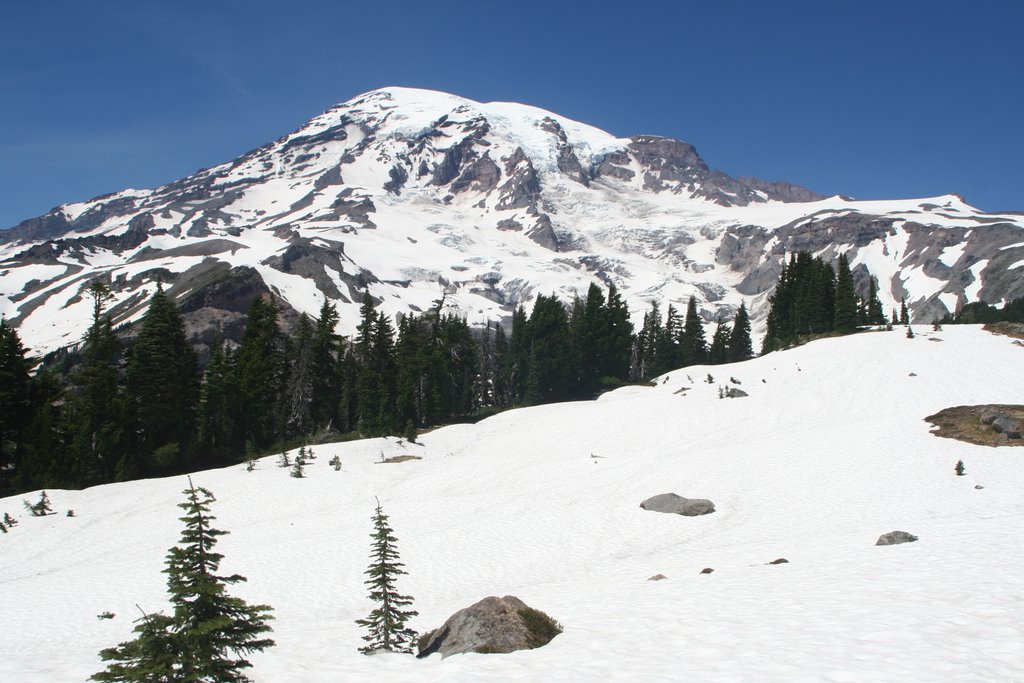
A couple of weeks ago, I was on Mt. Rainier (not at the summit, I wish that was the case though) and I was dearly missing my trusted Elan film camera. The mountain visibility was 100%. There was not a cloud in sight. This was the first time I had seen Rainier unobstructed. It was spectacular. There was lots of snow all over the trails, and the scene, whichever direction you looked, was incredible. Even though I was shooting lots of pics with my brand new digital Rebel XT, I missed my film camera.
I started wondering why I missed my good old slide film...
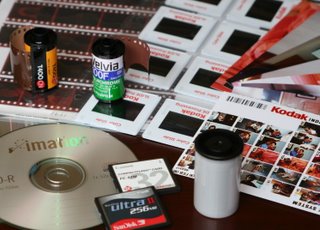
Projecting a crisp slide onto a screen has its own appeal. The sharpness, color saturation (I love to shoot sceneries with Velvia), and the immense nature of the projection that brings the subject to life. Of course, you can do the same with a digital image using an advanced digital projector. Still, I am partial to slides. For some reason slides feel immortal to me. I do know that they have limited longevity, especially if you project them often. But shooting them all these years, I have developed a great relationship with them.
Now that I have the digital SLR, and for some reason, I didn't feel like carrying two bodies (I already had three lenses in the bag) on this trip. And, I missed the opportunity of shooting slides of Rainier in its full glory.
That is when I started thinking about what I was doing all these years. Some fundamental questions popped in my mind.
- Why do I shoot all these pics?
- Why do I shoot slides (purpose)?
- Why do I shoot digital?
- What do I do with the pics I shoot? How do I use them?
- How do I store them?
- How should I store them?
Answering these questions would lead me to what I want to do, short as well as long term.
Why do I shoot?
I love creating things, art specifically. Photography is art, and I love creating it. I love capturing moods so I can re-experience it at my whim. I shot a tonne of pics when we visited Europe, and looking at the pictures, I can see all the intricate details in the art and architecture that I missed, live.
Why do I shoot slides?
Ever since I laid my hands on the first roll of chrome film, I haven't shot much print film. There is something magical about slides. Be it their crispness, ability to capture what you intended (WYShootIWYG), challenges due to its narrow range, its presentation or its coolness factor ("I shoot Chrome"), it has captivated me all these years.
Why do I shoot digital?
With the advent of digital photography with the ability to instantly see the results, it was insane not to jump onto the train. It offers great opportunities for proofing and improvisation on the spot. Ease of transmitting the images to others make this a great media.
What do I do with them?
Hmm, good question. It is a way of capturing memories and moods. I capture them and freeze the moment in time so I can relive it at a later time. I share them with friends/family in a variety of ways (slide shows, internet, etc.). Use them for artwork (by themselves, or as input).
How do I store them?
I store photos in albums as well as shoe boxes. Negatives go into archival quality storage sleeves. Slides go into archival slide storage sleeves. Digital pics are stored in CD-RW media.
Now that I have answered the questions, I need to make a decision on how much each of the media is going to be used, and when. I also need to decide on post-processing, storage and archival process.
Negatives and slides will last a lifetime if stored appropriately in archival storage sleeves in the right atmosphere. Until now, I have not seen any degradation in any of the images. So, I am satisfied with this storage mechanism.
As for digital pics, I am currently storing them on a hard disk as well as CD-RW media. Looking at the vulnerability of both hard disks and RW disks, I need to cook up another robust strategy. Hard drives can crash wiping out all the data. CDs can be easily scratched or destroyed by high temperatures. So, here is what I am planning on doing:
Burn pics into DVD-RWs and label them with the following-
- Name
- Description
- Creation date
- ReBurn date (creation date + 3 years)
- Master/Copy
I will burn my pics into two DVDs, master and copy. The master stays in a safe place. The copy is used for all other post-processing. Upon the arrival of reBurn date, the data in the master will be transferred (after thorough verification) into the media of choice on that date. If needed, the data is also converted into an appropriate format on the reBurn date. The same process is repeated after 3 years. I came up with 3 years assuming in that time, we would have seen a rebirth of storage technology.
I will tweak this process as and when necessary. Let us see how this is going to work.
Monday, May 29, 2006
Smart selling (or lack thereof)
One of my friends drives an Acura and was complaining about the crappy loaner he was given when he had his car serviced at the dealership. I know of several dealerships which do this. You own an expensive luxury vehicle, and you end up driving a sub-compact ordinary loaner for a day.
I fail the understand the stupidity of the dealerships in passing off such a great opportunity to sell/market new cars.
Imagine this:
- Dealership calls you to set up an appointment once they determine that your car is due.
- You take the car in, and are given a loaner which is an upgrade (1-2 levels above) of the car you dropped off.
- You drive the fully loaded upgrade loaner for a day.
- When you come back to pick up your car, you mention how good this loaner was.
- The attendant acknowledges, and casually mentions that his manager took the liberty of doing some calculations, and determined what it would take for you to upgrade to that class of car. And, hands you a "sealed" envelope with the information. AND stops talking. It is completely up to you to open the envelope and peek inside, or chuck it into the garbage.
- You (like most people), salivating over the upgrade, open the envelope.
- If you were one of the people who were sitting on the fence wrt this issue, you fall for it, and will be driving an upgraded vehicle next week!
This is one scenario. You can come up with various other approaches to accomplish the same. There is no compromise of information here. Note that the dealer intimately knows your current car, its condition, and, obviously, its current market value. And, he happens to sell/trade new cars. He is the best person to do the math and give you the above mentioned information. Of course, all this should be done in a very subtle and non-intrusive manner. I wonder when the dealerships will pick this up.
Maybe, that will make me go the dealer for my next service....
Monday, July 18, 2005
Google maps 2 ....
I was complaining about the lack of a scale on Google maps, and one of my friends pointed me to a pedometer. It is pretty cool. A very useful feature to measure distances by clicking points on a map. Cool interface too. But, Google still needs to add a scale to their maps so that one can get an idea of the 'scale', for a lack of words, of the map. At least, we have APIs that we can use and enhance/add functionality.
Saturday, July 2, 2005
Google maps
Today, I was using it to get directions to the DMV and it gave me the shortest distance to the destination. The shortest distance did not involve the fastest freeway. That got me thinking... Yes, Google maps is cool. But there is a lot of scope for improvement.
When it comes to directions, there are several factors that could be considered:
- Would I prefer to travel on freeways or highways?
- Can I use a carpool lane?
- If there is more than one route to the destination (of similar length), which would I prefer?
- What if one of the routes needs me to climb 2000ft. and I have an old jalopy?
- Would I prefer the scenic route or the shortest route?
- And so on and so forth...
When it comes to plain maps, what is with the missing scale? When does a map make sense without scale?
These options seem like a lot of questions to ask, but there are ways of efficiently implementing these options in a non-irritating way. Note that not all options apply to any one particular situation.
There could be other services like:
- Bookmarking favorite locations, and applying them while getting directions (touch points).
- Pictures of the destination.
- Satellite imagery of the destination/route. Oops, they already thought of this one.
- The current weather at the destination.
To implement the mentioned services, the server needs to contain all the information or be able to retrieve all the information in real time (like, lane restriction, weather pattern, geography, traffic patterns, etc.) . This wouldn't be a major challenge, but would make the tool more useful and customizable.
Subscribe to:
Posts (Atom)