Many of my friends (who are switching from film to digital) have asked me what to look for, in a digiSLR. So, I thought of writing about it to benefit a wider audience.
If you look at the camera from a very basic point of view, it is just an instrument to capture light. How we do it is secondary. The main goal is to channel the light and capture it with the highest fidelity. Creativity can be unleashed by controlling the light.
A film camera is nothing but an airtight box with a hole in the front. The simplest form is a pin-hole camera. In order to capture as much detail as possible, lenses were introduced to channel the light and focus it. Film was added into the light-tight box to capture the light forever (almost). An aperture and a shutter, in combination, would allow the right amount of light for the right amount of time to make an impression on the film.
Everything remains the same with a digital camera. The camera is still a light-tight box. The same aperture and shutter control the light, the same lenses channel and focus the light.
What is different though, is the absence of film. Instead of the film, we find a photo-sensitive microchip. The chip converts the light rays into ones and zeros and stores them electronically. The chip is dumb and just captures whatever photons that hit it. Unlike film, which captures data at the molecular level, the chip captures data in pixels. So, is it better to get a camera with the most number of pixels? In general, yes. But, not really. There are too many parameters to consider in determining the quality of an image, and number of pixels happens to be just one of them.
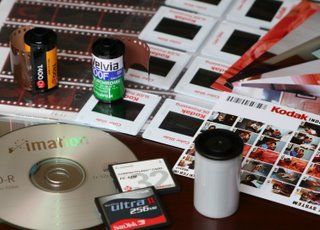
So, what happens to the cool variations I am used to getting with switching from Velvia to Kodachrome?
This is where electronics and software enters the picture. The sensor captures raw data. This data is massaged with the help of software to mimic the features of a film camera. The better the software, the better your camera. So, should you go for the camera with the latest and greatest whiz-bang software in it? Not necessarily. Every digiSLR is capable of capturing the raw image which I talked about. The format is appropriately called RAW. If you shoot pictures and store them in this format, you could use Photoshop or other photo editing software to work your magic.
If you store your pictures in JPEG format, the camera would have already performed its software magic (of course, under your orders) and saved a compressed image which is much smaller than the RAW image. But, unfortunately, you would have lost a lot of data during the process.
So, where does it leave us?
For a purist, all the same rules that applied to buying a film camera still applies. Spend the most of your budget on professional quality lenses, a sturdy tripod, and a powerful external flash. And, always shoot in RAW mode. Don't forget to buy lots of film, er, memory.
For the hobbyist, all the same rules apply. Spend the most of your budget on prosumer lenses, a sturdy tripod, and an external flash. Of course, get the best body that you can afford. With today's array of features, it sometimes is hard to choose. Most of the popular cameras come with almost all the features: multi-point focus, multiple metering modes (evaluative, center-weighed and spot being the most common) and a next to useless built-in flash.
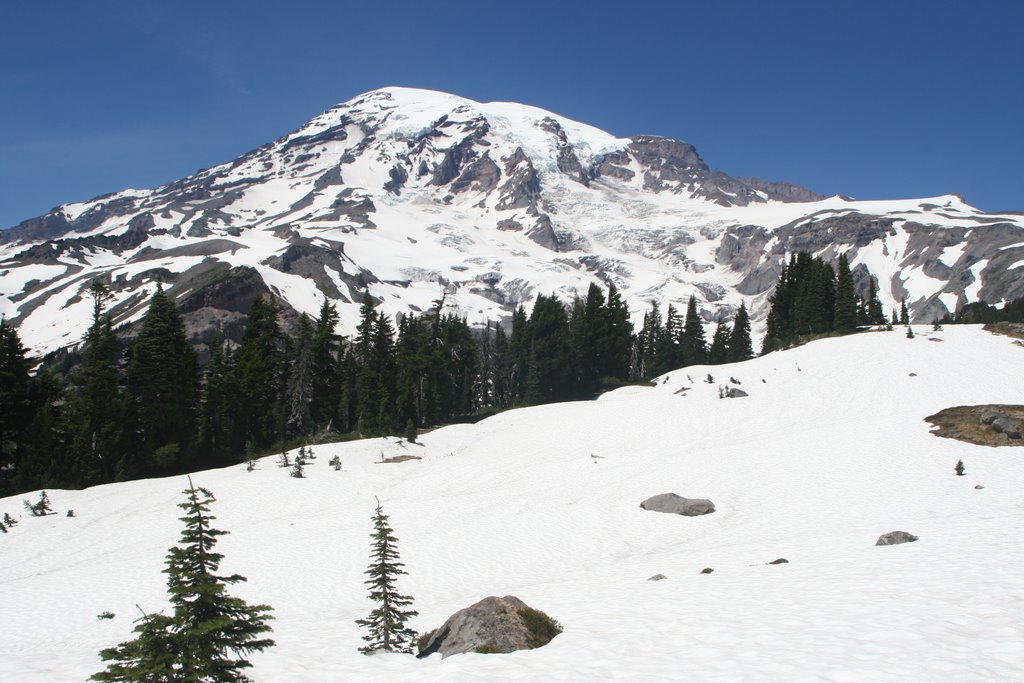
One feature worth considering while deciding is image stabilization. This is the ability of the camera (and lens, in some cases) to reduce the 'shake' in an image and improve its sharpness. This feature dramatically increases the range of shots you can shoot without a tripod. Something very useful. There are two types of systems: lens based and camera based. In the lens based systems, each individual lens comes with a built-in gyroscope to move lens elements to compensate for the shake. Pretty cool. The other system is where the sensor itself moves. The greatest advantage of the latter system is that it works with any lens in your bag. The photo above would have been crystal clear if I had image stabilization on my camera. It was shot hand-held at 1/10 sec shutter speed.
So, in short, things have not changed a lot, and a lot of the same reasoning still holds true. Just go get yourself a digiSLR and enjoy the ability to instantaneously preview your successes as well as mistakes!
If you look at the camera from a very basic point of view, it is just an instrument to capture light. How we do it is secondary. The main goal is to channel the light and capture it with the highest fidelity. Creativity can be unleashed by controlling the light.
A film camera is nothing but an airtight box with a hole in the front. The simplest form is a pin-hole camera. In order to capture as much detail as possible, lenses were introduced to channel the light and focus it. Film was added into the light-tight box to capture the light forever (almost). An aperture and a shutter, in combination, would allow the right amount of light for the right amount of time to make an impression on the film.
Everything remains the same with a digital camera. The camera is still a light-tight box. The same aperture and shutter control the light, the same lenses channel and focus the light.
What is different though, is the absence of film. Instead of the film, we find a photo-sensitive microchip. The chip converts the light rays into ones and zeros and stores them electronically. The chip is dumb and just captures whatever photons that hit it. Unlike film, which captures data at the molecular level, the chip captures data in pixels. So, is it better to get a camera with the most number of pixels? In general, yes. But, not really. There are too many parameters to consider in determining the quality of an image, and number of pixels happens to be just one of them.
So, what happens to the cool variations I am used to getting with switching from Velvia to Kodachrome?
This is where electronics and software enters the picture. The sensor captures raw data. This data is massaged with the help of software to mimic the features of a film camera. The better the software, the better your camera. So, should you go for the camera with the latest and greatest whiz-bang software in it? Not necessarily. Every digiSLR is capable of capturing the raw image which I talked about. The format is appropriately called RAW. If you shoot pictures and store them in this format, you could use Photoshop or other photo editing software to work your magic.
If you store your pictures in JPEG format, the camera would have already performed its software magic (of course, under your orders) and saved a compressed image which is much smaller than the RAW image. But, unfortunately, you would have lost a lot of data during the process.
So, where does it leave us?
For a purist, all the same rules that applied to buying a film camera still applies. Spend the most of your budget on professional quality lenses, a sturdy tripod, and a powerful external flash. And, always shoot in RAW mode. Don't forget to buy lots of film, er, memory.
For the hobbyist, all the same rules apply. Spend the most of your budget on prosumer lenses, a sturdy tripod, and an external flash. Of course, get the best body that you can afford. With today's array of features, it sometimes is hard to choose. Most of the popular cameras come with almost all the features: multi-point focus, multiple metering modes (evaluative, center-weighed and spot being the most common) and a next to useless built-in flash.
One feature worth considering while deciding is image stabilization. This is the ability of the camera (and lens, in some cases) to reduce the 'shake' in an image and improve its sharpness. This feature dramatically increases the range of shots you can shoot without a tripod. Something very useful. There are two types of systems: lens based and camera based. In the lens based systems, each individual lens comes with a built-in gyroscope to move lens elements to compensate for the shake. Pretty cool. The other system is where the sensor itself moves. The greatest advantage of the latter system is that it works with any lens in your bag. The photo above would have been crystal clear if I had image stabilization on my camera. It was shot hand-held at 1/10 sec shutter speed.
So, in short, things have not changed a lot, and a lot of the same reasoning still holds true. Just go get yourself a digiSLR and enjoy the ability to instantaneously preview your successes as well as mistakes!